What Manufacturers Should Know
Introduction
In recent years, we have received an increasing number of inquiries regarding servo-driven paper cup machines. Many customers are interested in understanding the differences when choosing a High Speed Paper Cup Forming Machine.
between a High Speed Paper Cup Forming Machine and a Mechanical cam driven paper cup machine before making a decision.
Many buyers are interested in servo technology due to its precision control and automation capabilities.
For this reason, we would like to share our perspective on servo-driven systems and discuss their advantages and
practical considerations in high-speed paper cup production.
In the competitive paper cup manufacturing industry, machine stability and long-term durability are critical factors.
Many manufacturers focus on production speed, but stability and maintenance costs often determine real profitability.
Mechanical cam-driven systems remain one of the most reliable technologies in high-speed paper cup machines.
As a long-established paper cup machine manufacturer in Korea,
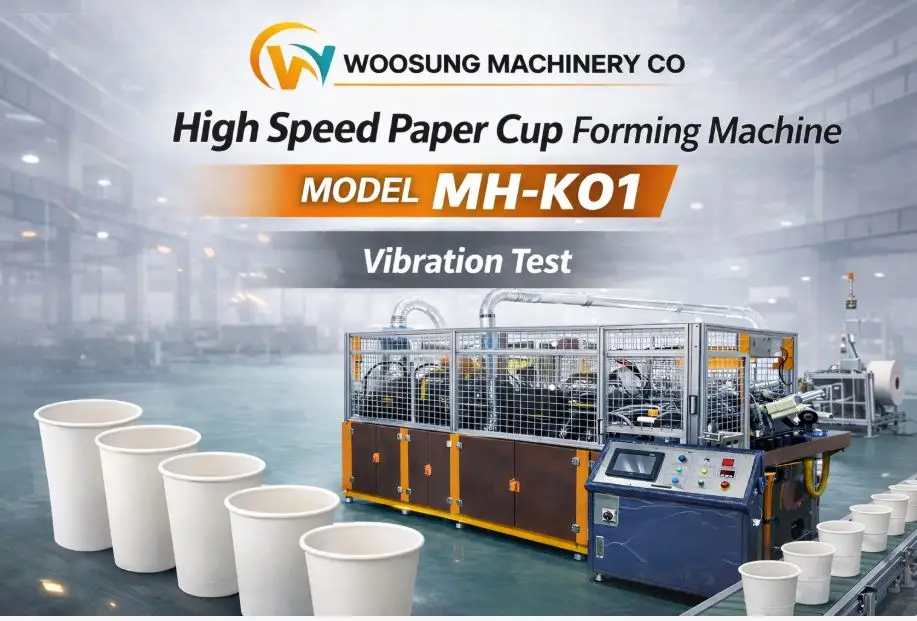
we have focused on mechanical cam-driven engineering for long-term stability for example WSGP1700, Super SH-K01 and MH-K01
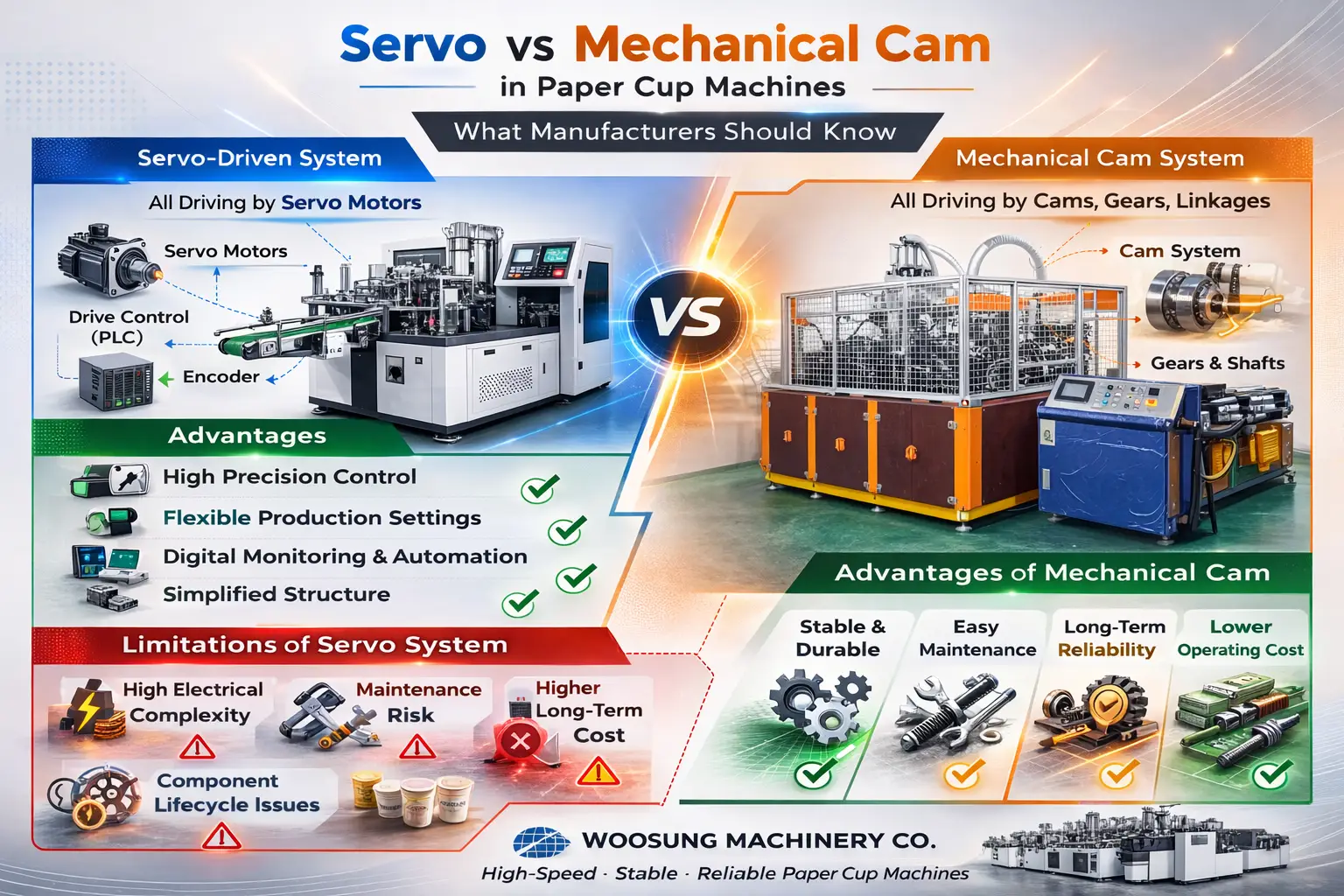
servo-driven paper cup forming machine means that all major motion components—such as the side sealing unit, mold rotation,
bottom paper feeding, and other driving mechanisms—are operated by servo motors.
In contrast, a mechanical paper cup forming machine operates through cams, gears, and mechanical link systems,
where motion is synchronized physically rather than electronically.
Therefore, while a servo-driven machine may appear structurally simpler, there are several important considerations
that should be carefully evaluated before making a purchase decision.
1.Advantages of Servo-Driven High Paper Cup Machines
1-1 High Precision Control
Servo systems allow precise control of motion, position, and speed.
Each station can be individually controlled, which offers flexibility in adjustment and configuration.
1-2 Flexible Production Settings
Changing production parameters can often be done through software adjustments rather than mechanical modification.
This makes servo systems attractive for operations requiring frequent size changes or customized settings.
1-3 Digital Monitoring & Automation
Servo systems integrate easily with PLC and digital control platforms.
Real-time monitoring, data tracking, and automation integration are convenient advantages.
1-4 Simplified Mechanical Structure
Compared to complex cam timing systems, servo systems may appear structurally simpler because synchronization is achieved electronically rather than mechanically.
2. Practical Considerations and Limitations
While servo systems provide clear advantages, high-speed continuous production environments require additional evaluation.
2-1. Increased Electrical Complexity
A multi-axis servo system typically includes:
-
Servo motors
-
Servo drives
-
Encoders
-
Motion control PLC
-
Communication networks
Because synchronization depends on electronic signals, electrical noise, signal interference, or communication errors may affect timing stability.
In high-speed production, even minor synchronization issues can cause downtime.
2-2 Maintenance and Repair Challenges
If a servo drive fails:
-
On-site repair is usually not possible
-
Replacement may require manufacturer-level technical support
-
Motion parameters may need to be recalibrated
In multi-axis systems, replacing one component may affect overall synchronization.
2-3 Component Lifecycle Risk
Electronic components evolve rapidly.
If a specific servo model is discontinued:
-
Exact replacement may not be available
-
New-generation models may not be fully compatible
-
PLC motion parameters may require adjustment
In long-term industrial use (5–7+ years), this can become a real operational concern.
2-4Higher Long-Term Ownership Cost
While servo systems offer digital advantages, long-term costs may include:
-
Higher replacement cost of servo drives
-
Specialized technical service requirements
-
Potential software or proprietary system limitations
For high-speed, continuous production lines, total cost of ownership must be carefully considered.
3 Servo driven vs Mechanical cam driven high speed paper cup machine
: Engineering Perspective
Mechanical cam-driven systems rely on physical timing synchronization.
They do not depend on electronic communication between motion components.
In many cases:
-
Maintenance can be handled locally
-
Mechanical wear patterns are predictable
-
Long-term durability is easier to manage
While servo systems provide flexibility, mechanical systems often provide greater stability in continuous mass production environments.
You can learn more about our mechanical cam-driven models here.
Conclusion
Servo-driven paper cup machines offer clear advantages in precision, flexibility, and digital integration.
However, in high-speed continuous production, long-term stability, serviceability, and component lifecycle management are equally critical factors.
A well-informed decision should be based not only on initial performance specifications, but also on long-term operational reliability.
AUTHOR: WOOSUNG MACHINERY CO
A Korean manufacturer specializing in high-speed paper cup machines.
Visit our official website:
👉 https://papercupmc01.com
Our machines are engineered and manufactured in accordance with internationally recognized ISO and CE standards to ensure safety, quality, and reliability.